


Page 11 - Dainfern Nature Association Booklet
P. 11
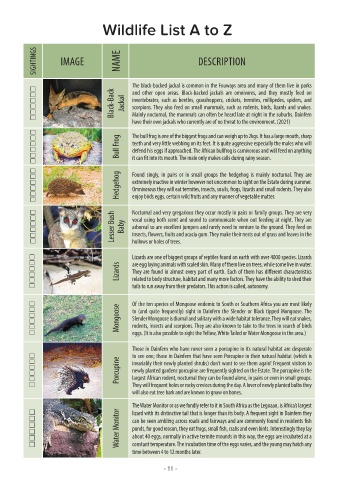
Wildlife List A to Z
SIGHTINGS IMAGE NAME DESCRIPTION
The black-backed jackal is common in the Fouways area and many of them live in parks
Black-Back Jackal invertebrates, such as beetles, grasshoppers, crickets, termites, millipedes, spiders, and
and other open areas. Black-backed jackals are omnivores, and they mostly feed on
scorpions. They also feed on small mammals, such as rodents, birds, lizards and snakes.
Mainly nocturnal, the mammals can often be heard late at night in the suburbs. Dainfern
have their own jackals who currently are of no threat to the environment. (2021)
Bull Frog The bull frog is one of the biggest frogs and can weigh up to 2kgs. It has a large mouth, sharp
teeth and very little webbing on its feet. It is quite aggressive especially the males who will
defend his eggs if approached. The African bullfrog is carnivorous and will feed on anything
it can fit into its mouth. The male only makes calls during rainy season.
Hedgehog Found singly, in pairs or in small groups the hedgehog is mainly nocturnal. They are
extremely inactive in winter however not uncommon to sight on the Estate during summer.
Omnivorous they will eat termites, insects, snails, frogs, lizards and small rodents. They also
enjoy birds eggs, certain wild fruits and any manner of vegetable matter.
Lesser Bush Baby Nocturnal and very gregarious they occur mostly in pairs or family groups. They are very
vocal using both scent and sound to communicate when out feeding at night. They are
arboreal so are excellent jumpers and rarely need to venture to the ground. They feed on
insects, flowers, fruits and acacia gum. They make their nests out of grass and leaves in the
hollows or holes of trees.
Lizards Lizards are one of biggest groups of reptiles found on earth with over 4000 species. Lizards
are egg laying animals with scaled skin. Many of them live on trees, while some live in water.
They are found in almost every part of earth. Each of them has different characteristics
related to body structure, habitat and many more factors. They have the ability to shed their
tails to run away from their predators. This action is called, autonomy.
Mongoose Of the ten species of Mongoose endemic to South or Southern Africa you are most likely
to (and quite frequently) sight in Dainfern the Slender or Black tipped Mongoose. The
Slender Mongoose is diurnal and solitary with a wide habitat tolerance. They will eat snakes,
rodents, insects and scorpions. They are also known to take to the trees in search of birds
eggs. (It is also possible to sight the Yellow, White Tailed or Water Mongoose in the area.)
Those in Dainfern who have never seen a porcupine in its natural habitat are desperate
to see one; those in Dainfern that have seen Porcupine in their natural habitat (which is
Porcupine invariably their newly planted shrubs) don’t want to see them again! Frequent visitors to
newly planted gardens porcupine are frequently sighted on the Estate. The porcupine is the
largest African rodent, nocturnal they can be found alone, in pairs or even in small groups.
They will frequent holes or rocky crevices during the day. A lover of newly planted bulbs they
will also eat tree bark and are known to gnaw on bones.
The Water Monitor or as we fondly refer to it in South Africa as the Leguaan, is Africa’s largest
lizard with its distinctive tail that is longer than its body. A frequent sight in Dainfern they
Water Monitor can be seen ambling across roads and fairways and are commonly found in residents fish
ponds, for good reason, they eat frogs, small fish, crabs and even birds. Interestingly they lay
about 40 eggs, normally in active termite mounds in this way, the eggs are incubated at a
constant temperature. The incubation time of the eggs varies, and the young may hatch any
time between 4 to 12 months later.
- 11 -

